 Lucas de Almeida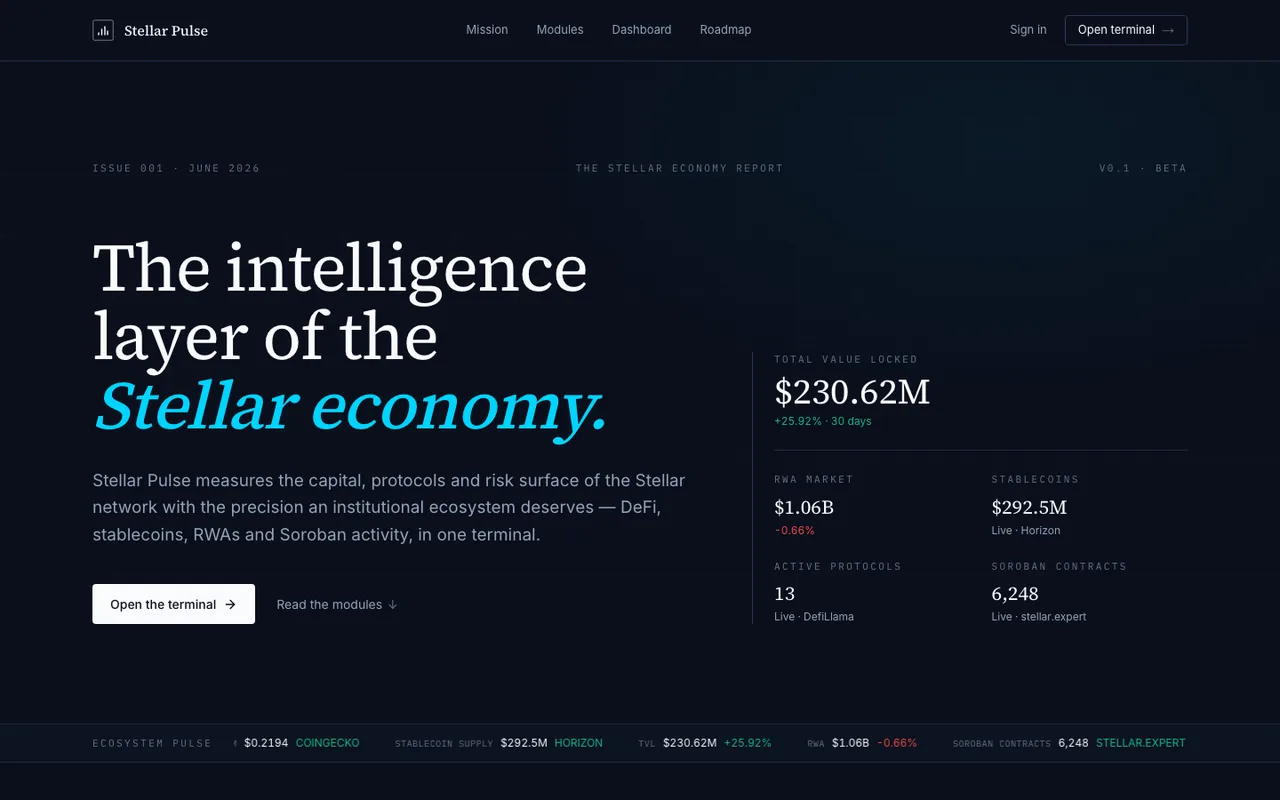
The problem
To understand the Stellar economy today you stitch together Horizon, stellar.expert, DefiLlama, CoinGecko and a spreadsheet. Worse, many dashboards show stale or made-up numbers without saying so.
How it works
A server-rendered Next.js 16 app with nine routes: TVL by protocol, stablecoin supply, capital flows, tokenised real-world assets, Soroban activity, a layered price oracle and a 0–100 trust score for the top protocols.
Every number goes through the same five-layer pipeline:
upstream API ─► adapter (fetch + Zod) ─► fallback (typed, logged) ─► aggregator ('use cache')
             ─► server component ─► presentational client component
Design decisions
- No silent mocks. Every row carries a source badge. If an upstream fails, the value is marked illustrative in the UI and a structured log line is written, never a quiet placeholder.
- Schemas at the edge. Every external response is parsed with Zod before it reaches the app, so a changed API breaks loudly in one adapter instead of quietly in a chart.
- A layered oracle. XLM/USD falls back from CoinGecko to the Reflector Soroban contract to the Horizon order book, with a 0.95–1.05 peg band that rejects nonsense prices.
- Assets are keyed by code and issuer. Asset codes like USDT collide on Stellar.
What could go wrong
This is a read-only app, so the risks are integrity and availability, not funds.
| Vector | Status |
|---|---|
| Poisoned or malformed upstream data | Mitigated: Zod validation per adapter, peg band on prices |
| Upstream outage | Mitigated: typed fallbacks, labelled as illustrative |
| Cache abuse | Mitigated: revalidation endpoint behind a secret |
| Malicious outbound links | Mitigated: 22-entry protocol registry, HTTPS only, noopener noreferrer, no javascript: or data: |
| Score gaming | Partly: the trust-score formula is public and deterministic, which helps review but is also easy to optimise for |
Where it stands
A demo is online with 192 passing tests. It's a learning project, not a maintained data product; numbers marked illustrative are exactly that.